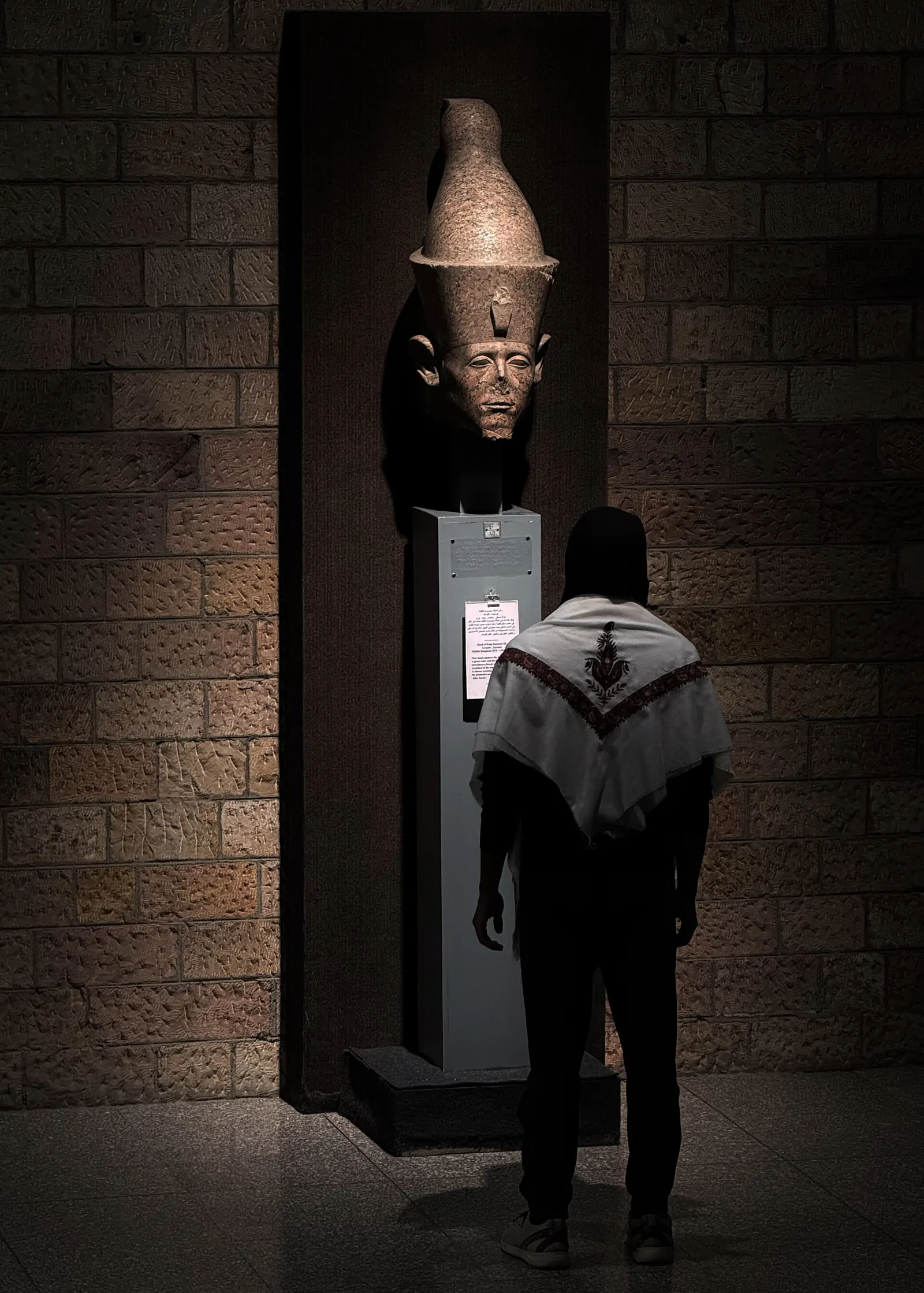
Do not begin by trying to translate. Begin by identifying how writing occupies a surface, what tool produced it and which kind of reader the object could reach.
THE FOUR-STATION TRAIL
Follow writing as an action.
- 1
Identify the surface
Stone invites carving; papyrus, pottery and plaster accept ink; metal and wood permit other tools. Surface size and preparation shape layout.
- 2
Find direction and grouping
Look for columns, ruled lines, margins, repeated groups and the orientation of human or animal signs. Do not assume modern left-to-right order.
- 3
Separate script from language
Hieroglyphic, hieratic, Demotic, Coptic, Greek and Arabic are not interchangeable categories; script and language answer different questions.
- 4
Infer the writing event
Monumental commemoration, accounting, letter, exercise, prayer and ownership mark involve different makers, readers and durations.
ERRORS AND REVISIONS
Writing preserves process.
Corrections, overwritten signs, changed ink, spacing pressure and reused surfaces reveal composition. A finished inscription may look inevitable; an ostracon or draft can expose training and revision.
Visibility is also political. Large formal text and tiny administrative notation address different publics, but both organize power and resources.
QUESTIONS TO CARRY
Ask who could use the text.
- Was the writing meant to be read, seen or ritually present?
- Which tool and gesture produced the marks?
- Does the text belong to the object’s first use?
- What is image, what is writing and where do they overlap?
- Are corrections or multiple hands visible?
- Which readers are assumed by the museum translation?
Source path
Use the holding catalogue for script, language, transliteration and provenance. Palaeography, material analysis and archaeological context are required before dating handwriting or assigning a text type.